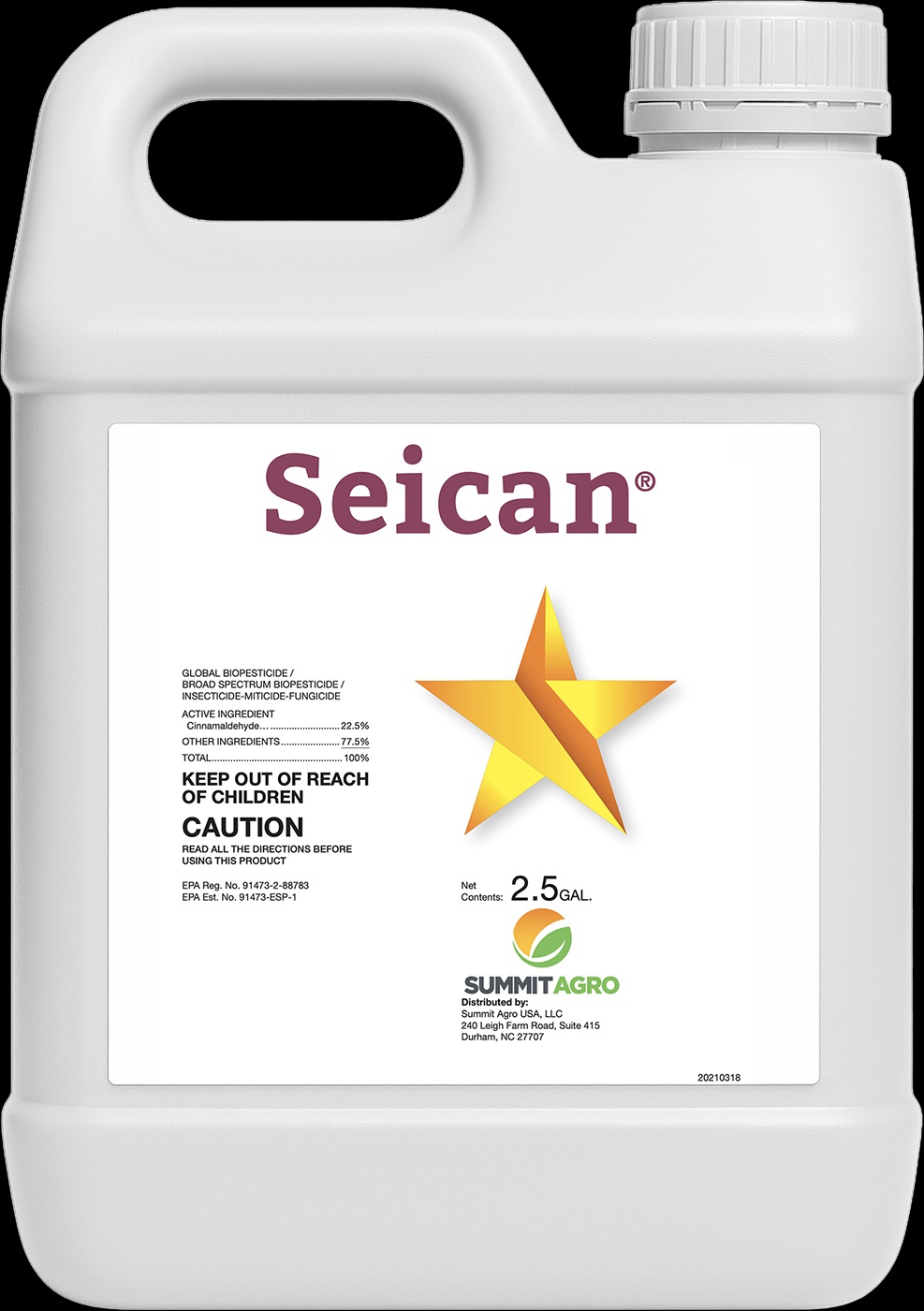
ACTIVE INGREDIENT
Cinnamaldehyde… 22.5%
OTHER INGREDIENTS… 77.5%
TOTAL… 100%
Use Information
Begin applications at the appearance of the first signs of pests/mites or diseases. Repeat applications as required to maintain effective control, but no more than every 5 days. Under moderate to severe disease pressure, or when environmental conditions and plant stage are conducive to rapid pest/mite or disease development, use higher label rates, apply more frequently and rotate SEICAN with other
insecticides/miticides or fungicides for improved performance. Refer to the “Crop Uses” section of the product
label for a complete list of crops.
For foliar application, apply SEICAN in a sufficient spray volume and with adequate spray pressure to ensure complete and thorough coverage of all plant surfaces including both the top and bottom of leaves. Do not wet plant to the point of runoff or drip.
pH: It is advisable to use SEICAN in a pH water solution adjusted to neutral or slightly acid (around 6 – 6.5).
SEICAN is designed for application without additional wetting
agents and spreaders. Use adjuvants with SEICAN to improve
control of insect and mite pests in situations where achieving
uniform plant coverage is difficult such as closed crop canopy,
dense foliage and penetration into waxy leaf surfaces or when
rainfall may remove spray deposits.
Please read label application instructions for best results.
Use Rates
Rate per 100 gallons-
First presence-16 fl.oz. per acre Frequency 5-7 days
Common Rate-32 fl.oz per acre Frequency 5-10 days
High Pressure-48 fl.oz.per acre to 56 fl.oz. per acre Frequency 5-7 days
GROUND APPLICATIONS:
SEICAN can be applied in most commonly-used ground application equipment, such as
tractor-mounted boom, airblast high clearance, hose-end, backpack, and other pressurized sprayers; hose-end or handheld sprayers; foggers or mist blowers; water wheel and other drench applicators; and shank or other soil injection methods.
This product must come into contact with the targeted pests to be effective. For best results coverage typically requires a minimum of 30 gallons of total spray volume per acre. Higher volumes will be required for larger perennial crops.
When pest pressure is heavy or plant canopy is dense, use higher rates and increase spray frequency. Repeat application if measurable rain occurs within two to three hours of spraying.
AERIAL APPLICATIONS:
SEICAN can be applied by fixed or rotary winged aircraft in a minimum of 30 gallons of total spray
volume gallons per acre. Standard precautions should be taken to minimize spray drift.
Crop Uses
Legume vegetables
- Bean, Broad beans, Chickpea, Guar, Jackbean, Lablab bean, Lentil, Peas (dwarf pea, edible pod pea, English pea, field pea, garden pea, green pea, snow pea, sugar snap pea), Pigeon pea, Soybean, Sword bean
Cereal grains
- Fresh sweet corn, Dried field corn, Rice, Sorghum, Wheat, Barley, Buckwheat, Pearl millet, Proso millet, Oats, Popcorn, Rye, Teosinte, Wild Rice
Fruits, Citrus and Nut Trees
- Apricots, Cherries, Nectarines, Peaches, Plums, Prunes
- Apples, Crabapples, Pears, Quinces
- Oranges, Lemons, Limes, Grapefruits, Kumquats, Mandarins
- Almonds, Pecans, Pistachio, Walnuts
Brassica (Cole), Bulb and Root and Tuber Vegetables
- Broccoli, Cabbage, Chinese Cabbage, Cauliflower, Kale
- Garlic, Leeks, Onions, Shallots
- Artichokes, Sugar beet, Chicory, Ginger, Ginseng, Horseradish, Potatoes
Legume Vegetables, Cereal Grains and Forage and Grasses
- Beans, Lentils, Peas, Soybeans
- Barley, Corn, Millet, Oat, Rice, Sorghum, Triticale, Wheat
- Any grass that will be fed to or grazed by livestock
Leafy, Fruiting and Cucurbit Vegetables
- Celery, Endive, Lettuce, Parsley, Radicchio, Mustard greens, Turnip greens
- Chayote, Chinese cucumber, Citron melon, Cucumber, Melons, Pumpkin, Squash, Watermelon
- Eggplant, Ground cherry, Okra, Pepper, Tomato
Small Fruits, Berries and Grapes
- Blackberry, Blueberry, Cranberry, Currant, Grapes, Guava, Raspberry, Strawberry
Herbs, Spices and Other Crops
- Alfalfa, Basil, Chives, Cilantro, Dill, Mint, Oregano, Parsley, Pasture, Thyme.
- Avocados, Bananas, Dates, Figs, Mangoes, Pomegranate, Papaya, Pineapple, Acerola, Artichoke, Cacao, Carob, Cherimoya, Cocoa, Coffee, Hops, Lychee, Mamey sapote, Mushroom, Okra, Olives, Palm, Passion fruit, Peanuts, Persimmon, Sugar cane, Sunflower, Tea, Tobacco
Ornamentals; Turf; Lawns; Golf Courses; Trees
- Ornamental Plants and Shrubs, Turf, Lawns, Golf Courses
- Christmas trees, shade trees, nursery trees, ornamental trees, landscape trees.
Greenhouse Uses
- Vegetables, Herbs, Spices
- Ornamental plants, shrubs and trees; bedding plants; flowers
Reviews
There are no reviews yet.